250 Years Since Adam Smith Published The Wealth of Nations: The Book That Rewrote the World
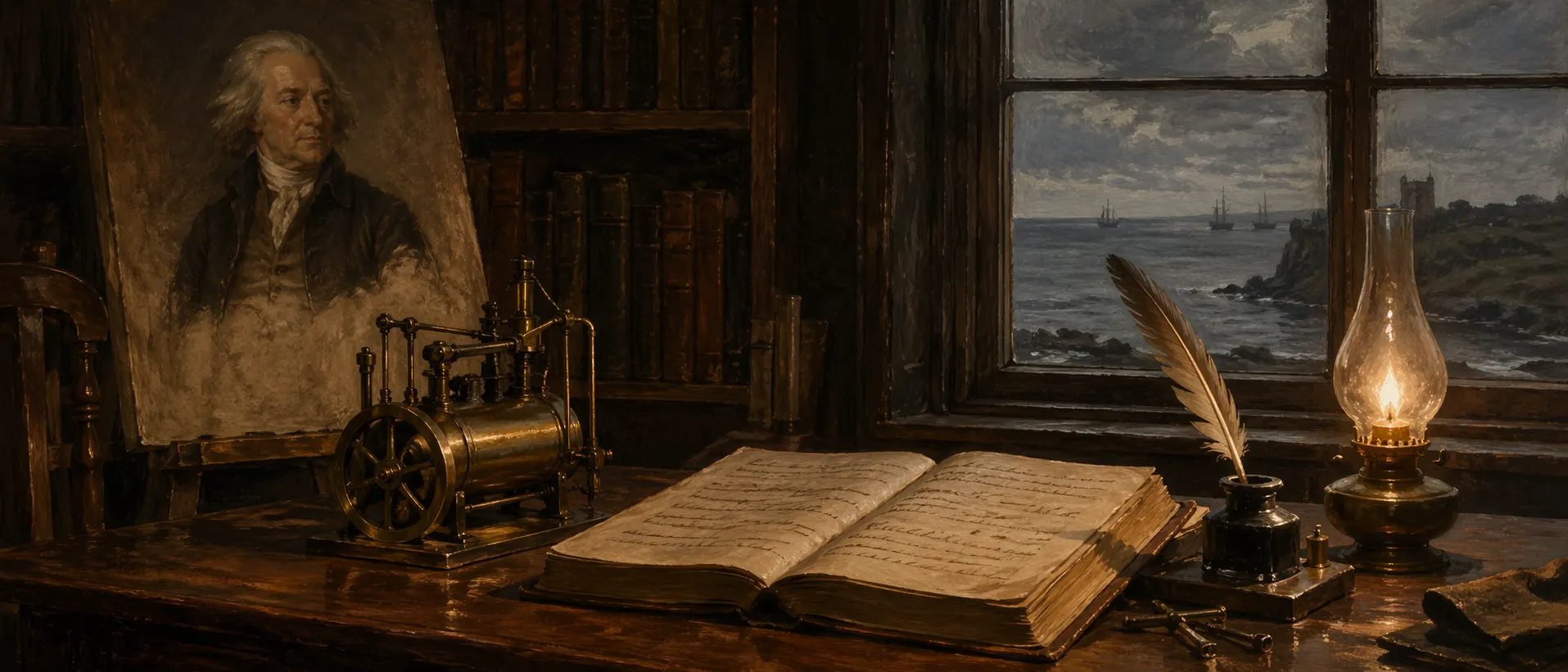
Two Scots, one week, two inventions that would remake civilization.
In the first half of March 1776, in two small places separated by a few hundred miles of rutted English road, two Scotsmen put something into the world that neither of them fully understood the scale of. On one side, a gasping iron beast in the coalfields of the Midlands. On the other hand, a dense two-volume book that almost nobody had been waiting for. Taken together, they ended the feudal world and started ours.
The book was An Inquiry into the Nature and Causes of the Wealth of Nations. Its author was Adam Smith, a shy, absent minded moral philosopher from Kirkcaldy who had spent the previous decade writing it, often pacing the shore of the Firth of Forth while dictating to himself. It was published on 9 March 1776 by William Strahan and Thomas Cadell in London, in two quarto volumes priced at £1 16s, with the author listed modestly on the title page as "Adam Smith, LL.D. and F.R.S., formerly Professor of Moral Philosophy in the University of Glasgow." The first edition sold out in six months.
The day before, or within the same week depending on which parish record you trust, Boulton and Watt completed and fired the first commercial installation of James Watt's improved steam engine. It stood at Bloomfield Colliery, just outside the village of Tipton in the Midlands. Its cylinder had been bored by John Wilkinson to a tolerance, as Matthew Boulton wrote at the time, of less than the thickness of an old shilling, on a diameter of 50 inches. It pumped water out of a flooded coal mine more than three quarters more efficiently than the Newcomen engines that had preceded it. A second engine, at Wilkinson's own ironworks at Broseley, fired the following month. A third, at Stratford-le-Bow in east London, was running by the summer.
One machine gave the modern world its muscle. The other gave it its nervous system, a way of thinking about itself.
And yet if you had walked down the Strand on the morning of 9 March 1776 and told a passerby that a Scottish philosopher had just published the blueprint for the next two and a half centuries, they would have laughed at you. The American colonies were in open rebellion. Lord North's government was preoccupied. Edward Gibbon's Decline and Fall of the Roman Empire, published a few weeks earlier, was the book everyone was actually talking about. Smith's publisher Strahan wrote drily that Gibbon's work required less thought and was therefore "the most popular," while The Wealth of Nations was selling better than expected only because readers willing to think hard were rarer than he feared.
The philosopher nobody expected
Adam Smith was baptized at the Old Kirk in Kirkcaldy, Fife, on 5 June 1723. His father, also called Adam, had been Comptroller of Customs for the Kirkcaldy district and had died five months before his son was born. His mother, Margaret Douglas, daughter of a local landowning family, raised him alone. The two were inseparable for the rest of her life. Smith never married. When she died in 1784 he was devastated.
Kirkcaldy was then a port of roughly 1,500 people, exporting coal, salt and linen. The boy would have watched ships load on the quayside almost daily. When he was three or four, according to the story that followed him through every biography, he was briefly kidnapped by a band of travelling Roma while visiting relatives inland and was quickly rescued by his uncle. John Rae, his principal nineteenth century biographer, remarked that he "would have made, I fear, a poor gipsy."
At fourteen he entered the University of Glasgow. There he fell under the influence of Francis Hutcheson, the moral philosopher whose idea that human beings make moral judgments through sentiment rather than pure reason would shape Smith's entire intellectual life. In 1740 a Snell Exhibition scholarship took him to Balliol College, Oxford. He hated it. He later wrote that the Oxford professors had "given up altogether even the pretense of teaching." He taught himself instead, reading voraciously in the library, and in 1746 returned home to Kirkcaldy frustrated and unemployed.
A series of public lectures on rhetoric in Edinburgh, arranged by Lord Kames, rescued him. They were a success. In 1751 he was appointed Professor of Logic at Glasgow and a year later took the chair of Moral Philosophy. He tried to secure a chair for his friend David Hume. The clerical establishment blocked Hume on grounds of his atheism. Smith never forgave them, though the Glasgow years were otherwise happy. He was a famously distracted lecturer who sometimes forgot where he was mid sentence, but students crowded in.
It was at Glasgow that he met James Watt. Watt had been blocked from setting up as an instrument maker in the city by the Guild of Hammermen, who insisted he had not served the required apprenticeship. The university, not bound by guild rules, gave him a workshop in 1757. Joseph Black, the chemist who would discover latent heat, was Watt's scientific sponsor. Smith was his protector and friend. In his retirement Watt would make a small sculpted portrait head of Adam Smith on one of his own copying machines. The affection was real.
In 1759 Smith published The Theory of Moral Sentiments. It was a sensation across Europe. Kant called Smith his Liebling, his favorite among the British moralists. Voltaire, who met Smith on his Grand Tour a few years later, said, "This Smith is an excellent man. We have nothing to compare with him, and I am embarrassed for my dear compatriots."
Charles Townshend, Chancellor of the Exchequer and a man with an unfortunate later role in American history via the taxes that bear his name, read the Moral Sentiments and hired Smith as tutor to his stepson, the young Duke of Buccleuch. Smith resigned his Glasgow chair, collected a lifetime pension, and in 1764 set off with the Duke on a three year Grand Tour of France and Switzerland. In Geneva he sat with Voltaire. In Paris, through Hume, he met François Quesnay, personal physician to Louis XV and the most important economic thinker in France. Quesnay's Tableau Économique of 1758 had already attempted something no one had attempted before, a full circuit diagram of how wealth flowed through a society. Smith was impressed enough that he had originally planned to dedicate The Wealth of Nations to Quesnay, who died before he could.
The Duke's younger brother died in Paris in 1766, and the tour ended abruptly. Smith spent a few months in London, advising on policy and writing, then returned to Kirkcaldy in 1767 and began, in earnest, the book he had been thinking about for nearly twenty years.
The invisible hand and what Smith actually meant
The Wealth of Nations is five books long and runs to something over a thousand pages. It is not an easy read. Most of the people who invoke it have not read it. This is part of its problem.
The first book, which takes up roughly the first 250 pages of the work, is about labor. Specifically, about the division of labor, which Smith introduces with the pin factory, one of the most famous passages in economic writing. A single worker making pins from scratch might, Smith writes, produce one a day, perhaps not even that. Ten workers splitting the operation into eighteen distinct tasks, one drawing wire, one cutting it, one sharpening, and one making the head, can produce nearly 48,000 pins a day. The productivity gain is not marginal. It is roughly a 4,800 fold increase. From this observation he builds outward. Specialization requires exchange. Exchange requires money. Money makes generalized production possible. From this simple triad he extracts the whole system of prices, wages, profits, rent, and the growth of capital.
Book Two is about the accumulation of capital and its use. Book Three is historical, tracing how the medieval agricultural economy gave way to towns, manufacture, and the long dissolution of feudal dependency. Book Four is the famous attack on mercantilism, the policy of running trade surpluses through tariffs and monopolies and chartered companies that was the orthodox view in every European capital. Book Five is about public finance, the duties of the sovereign, taxation, and public works.
It is in Book Four, buried in a passage about whether a British merchant would choose to invest at home or abroad, that Smith drops the phrase that has eaten his reputation ever since. Every individual, he writes, pursuing his own advantage, is "led by an invisible hand to promote an end which was no part of his intention. Nor is it always the worse for the society that it was no part of it. By pursuing his own interest, he frequently promotes that of the society more effectually than when he really intends to promote it."
That is the whole passage. It appears once in The Wealth of Nations. Once. Smith uses it to make a fairly modest point about why protectionist capital controls are unnecessary.
He follows it almost immediately with the butcher, the brewer and the baker. "It is not from the benevolence of the butcher, the brewer, or the baker that we expect our dinner, but from their regard to their own interest. We address ourselves, not to their humanity but to their self-love."
These two lines, wrenched out of a thousand page moral economy, have been made to do more ideological work than perhaps any other sentences in English prose. Smith's point is not that selfishness is virtuous. His entire earlier book, The Theory of Moral Sentiments, argued the opposite, that human moral life is founded on sympathy, on the capacity to imaginatively enter the feelings of others. His point in The Wealth of Nations is narrower and stranger. It is that a properly ordered commercial society can channel ordinary self interest into cooperation without requiring everyone to be a saint and that this is a moral achievement, not a moral failure. It liberates the baker from having to love you. It liberates you from having to beg.
The distortions
Smith became a victim of his own fame almost immediately. Before the American Civil War, southern politicians invoked him against northern tariffs because they liked the free trade argument. They ignored that he had condemned slavery as both morally wrong and economically irrational, on productivity grounds. He appears nowhere in northern rhetoric of the period, because the South had claimed him. He was a symbol by then, not a thinker.
The second distortion is the one that survives. It is the Smith of the Homo Economicus textbook, the prophet of pure self interest and the minimal night watchman state, the man who supposedly argued that any government intervention disturbs a natural harmony ordained by providence. This is, more or less, a fabrication.
Read him. He calls monopolists guilty of an "unfortunate spirit" that exploits every opportunity "to acquire privileges, influence laws, and enter into agreements with other companies." He writes that "people of the same trade seldom meet together, even for merriment and diversion, but the conversation ends in a conspiracy against the public or in some contrivance to raise prices." He supports public education, public infrastructure, and progressive taxation, writing that "it is not very unreasonable that the rich should contribute to the public expense, not only in proportion to their revenue but also something more than in that proportion." He describes civil government, with cold clarity, as being "in reality instituted for the defense of the rich against the poor."
That is not a libertarian speaking. That is a moral philosopher with a very clear eye.
Smith's actual argument was that the feudal world, in which a peasant's labor and loyalty belonged to his lord by birth, had given way, through a lucky historical accident, to a commercial world in which a person could sell their labor to whomever offered the best price. This was emancipation. It was also fragile, requiring the rule of law, independent courts, and institutions strong enough to resist the rent seeking of merchants and manufacturers who would, if left alone, collude and capture the state. The market was a moral institution, not a natural one. It had to be built and defended. Take away the institutions, and you've got not freedom but monopoly.
Jesse Norman, whose biographical study Adam Smith: What He Thought and Why It Matters has done more than any recent book to recover this picture, puts it bluntly. Smith was not the father of capitalism as it is usually imagined. He was its first and most intelligent critic, writing before it had even properly begun.
The letter about Hume
Smith's happiness at the book's success was cut short. In August 1776, five months after publication, David Hume died of intestinal cancer in Edinburgh. Smith had visited him in the final weeks. He was stunned by how his friend faced death, an atheist and a skeptic, without fear, without repentance, cheerful, joking with his servants, and writing a short autobiography.
Smith sat down and wrote a long letter to his publisher William Strahan describing Hume's last days. He ended it with a sentence that became one of the most quoted, and most controversial, passages of the English eighteenth century. "Upon the whole, I have always considered him, both in his lifetime and since his death, as approaching as nearly to the idea of a perfectly wise and virtuous man as perhaps the nature of human frailty will permit."
The letter was printed. It caused a greater scandal, Smith later said, than anything in The Wealth of Nations. The idea that an unbeliever could die well, without God, without fear, was intolerable to many. Smith had not expected the reaction. He was shaken by it.
He kept working. In 1778 he was appointed Commissioner of Customs for Scotland, a sinecure his father had held, and moved with his mother and his cousin Janet Douglas to Panmure House in Edinburgh, where he hosted supper parties for Joseph Black; James Hutton, the geologist; Edmund Burke when he visited, and the young Robert Burns, who would later call Smith the greatest philosopher of his age. The sixth edition of The Theory of Moral Sentiments, heavily revised, appeared in 1790. It is a darker book than the first edition. The commercial society Smith had helped to theorize was visibly beginning, and he had started to see its sharper edges. The section he added on "the corruption of our moral sentiments, which is occasioned by this disposition to admire the rich and the great and to despise or, at least, to neglect persons of poor and mean condition" is among the most uncomfortable things he ever wrote.
He died on 17 July 1790. His estate was much smaller than anyone expected. It turned out he had been quietly giving away most of his income for years to poor families in Edinburgh. The poor of the Canongate came to the funeral in large numbers. Very few of his grand friends did.
What is left
Two hundred and fifty years on, the world Smith helped to describe has outrun him in ways that would probably have alarmed him. The pin factory has become the global supply chain. The invisible hand has been dressed up as an algorithm. Mercantilism, which he spent two books demolishing, has come roaring back under new names, in Beijing and Washington, with tariffs and industrial policy and export restrictions on strategic goods. The "unfortunate spirit of monopoly" is alive and publicly traded in Silicon Valley. The idea that civil government is instituted for the defense of those who have property against those who have none is not exactly a fringe view in 2026.
Smith would, I think, recognize all of these developments. He would recognize the capture of the regulatory state by the industries it supposedly regulates. He would recognize the rent seeking dressed up as innovation. He would recognize the fact that the freer a market is, the more effort concentrated capital will put into making it less free once it has won. He wrote about all of this. He was not naive.
He would not recognize the cartoon version of himself depicted as the free market prophet on the Adam Smith Institute tote bag. That is someone else's Adam Smith. The real one was a moral philosopher who happened to be the greatest economist who ever lived, not the other way round. He believed people were kinder than markets assumed, crueller than moralists liked to admit, and capable, under the right institutions, of building something remarkable together almost by accident. He thought the worst outcome was to let a small group of merchants and manufacturers write the rules.
On a coal field in Tipton, on 8 March 1776, the pump at Bloomfield Colliery began to turn, and the water began to come up out of the mine in volumes no human or horse had ever delivered. A hundred and twenty miles away, on the 9th, Strahan's presses ran off the first copies of a book almost nobody had been waiting for. The two Scotsmen behind them had known each other for nearly twenty years. They had drunk together in Glasgow. They had argued. They were friends.
One of them put the engine in the machine. The other put the machine in our heads. We are still running on both.