A Super El Niño in 2026? What the Pacific Is Quietly Telling Us
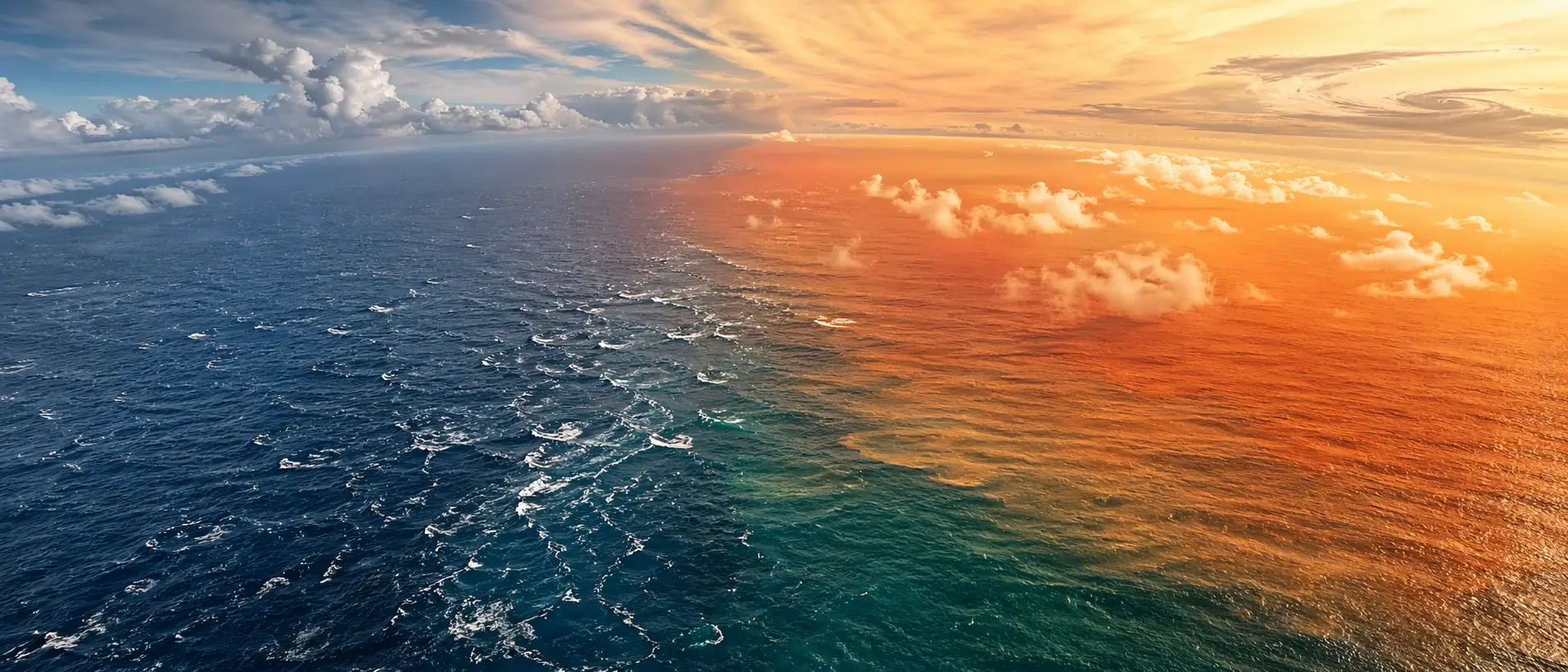
Something is brewing in the water between Peru and Indonesia. The trade winds that normally push warm surface water toward Asia are weakening, and beneath the sea, a slab of unusually warm water roughly the size of the continental United States is sliding eastward. If it reaches the surface and stays there, 2026 could deliver the kind of weather year that climate scientists usually describe with four-letter words.
The U.S. National Oceanic and Atmospheric Administration now puts the odds of El Niño emerging between May and July at around 61 percent. Roughly one in four chance that it becomes strong. And a growing minority of forecast models, including the European one that has historically outperformed its peers on seasonal outlooks, suggest something more unusual. A super El Niño. Possibly the strongest on record.
That last bit deserves a pause. The strongest on record is a very high bar. It would mean surpassing 2015 to 2016, which itself tied with 1997 to 1998, which itself broke the records of 1982 to 1983. Each of those events cost the global economy trillions of dollars and left ecosystem scars that haven't healed. Nobody who lived through them forgets.
How a patch of warm water reorganizes the planet
El Niño is not weather. It is a reorganization of how heat and moisture are distributed across the Pacific, and because the Pacific covers roughly a third of Earth's surface, that reorganization shows up everywhere else.
Under normal conditions, easterly trade winds drag warm surface water from South America toward Indonesia, piling it up on the western side of the basin. Cold, nutrient rich water rises along the coasts of Peru and Ecuador to replace it. Fish thrive. Rain falls over Southeast Asia and northern Australia. Cold, dry air sinks over the eastern Pacific.
When those winds slacken, the warm pool sloshes back east. The boundary between warm surface water and cold deep water flattens. Upwelling slows or stops. And the atmosphere follows the water. Storm tracks shift. Jet streams wander. Rainfall moves from places that expect it to places that don't.
A "super" event, informally defined as water temperatures more than 2°C above average in the central equatorial Pacific, turns the dial up hard. Five such events have occurred since 1950. The signal from each one reached every continent.
What happened the last time
The 2015 to 2016 super El Niño is the closest analogue we have, and it is not a comforting one.
In Indonesia, drought and peat fires sent smoke plumes across Southeast Asia so thick that schools closed in Singapore. Daily CO2 emissions from those fires briefly exceeded the emissions of the entire United States economy. In southern Africa, maize yields collapsed by up to 50 percent compared to the five-year average, and roughly 23 million people needed emergency food aid. In the Horn of Africa, drought deepened an already grinding crisis. The Philippines lost 327 million dollars in agricultural production. India saw below-normal monsoon rainfall for a second consecutive year.
The oceans took the worst of it. The third ever global coral bleaching event started in 2014 and ran through 2017, making it the longest on record. At Jarvis Island in the central Pacific, hard coral cover crashed from 18.7 percent to 0.4 percent in a single year. A 98 percent decline. On Japan's Iriomote Island, 94 percent of corals bleached. Three quarters of Okinawa's largest reef died.
Then there was the heat. El Niño releases stored ocean heat into the atmosphere, and in 2016 that release pushed global surface temperatures to what was then an all time high. The Atlantic, meanwhile, had a suppressed hurricane season because the strong upper level winds generated by El Niño tear apart developing tropical systems before they can organize. The Pacific did the opposite. Hurricane Patricia that October became, by some measurements, the strongest hurricane ever reliably measured, with sustained winds of 215 mph off the Mexican coast.
Total global economic hit from that single El Niño event once follow-on effects were counted across the subsequent years? Roughly 3.9 trillion dollars in lost output, according to analysis published in Nature Communications. The 1997 to 1998 event cost around 2.1 trillion. These are not disaster relief numbers. They are the compounding drag on economies that grow more slowly for years after an El Niño because infrastructure was damaged, crops failed, and people got sick.
Why this one could be different
Climate change doesn't cause El Niño. The phenomenon has existed for millions of years, cycling through the Pacific on roughly a two to seven year schedule. What climate change does is change the starting conditions.
The ocean is warmer now than it was in 2015. Substantially warmer. The past decade has been the hottest on record, and 2024 briefly pushed global average temperatures past the 1.5°C threshold that the Paris Agreement was designed to avoid. A study published this March found that the pace of global warming has nearly doubled since 2015 once short term fluctuations are accounted for.
Drop an El Niño on top of that, and the floor under the phenomenon is higher. The heat released doesn't just push temperatures up. It pushes them up from a baseline that is already running hot. This is why Ian Faloona, a micrometeorologist at UC Davis, has been warning that a 2026 or 2027 that combines a strong El Niño with current background warming could shatter temperature records in ways that feel genuinely new.
There is also a subtler concern. A December 2025 study found that super El Niño years can trigger what researchers call "climate regime shifts." Sudden, persistent changes in regional climate systems that don't revert when the El Niño ends. The Gulf of Mexico, for instance, reached a new sustained level of warmth after the 2015 to 2016 event and has held that warmth through multiple hurricane seasons since. The Gulf Coast has seen noticeably stronger storms as a result. You cannot undo that by waiting for La Niña.
The forecast problem
Here is where I have to be honest about the limits of what we know. Spring is the worst time of year to forecast El Niño. Meteorologists call it the "spring predictability barrier," and it exists because the atmospheric patterns that determine whether a warm Pacific will develop into a full event are themselves in flux during the Northern Hemisphere spring. Models tend to overestimate intensity. They also sometimes miss entirely.
In March 2026, the multimodel ensemble gave roughly a 47 percent chance of El Niño developing by April to June. By the May to July window, that probability climbs past 72 percent in some model runs. But the range of possible outcomes is wide. Some models show a marginal event. Others show something that would exceed 2015 to 2016. The difference between those outcomes, in human terms, is the difference between a mildly strange year and a genuinely dangerous one.
What we can say is that the subsurface temperature anomaly, the warm water sitting below the surface waiting to upwell, has been strengthening steadily since late winter. That is the clearest physical precursor we have. The Niño 3.4 index, which measures sea surface temperatures in a defined box of the central Pacific, is still running slightly cool, but the trajectory is unmistakable.
Clearer data will arrive in late summer. By August, the spring barrier has dissolved, and the ocean has usually committed one way or the other.
What to watch for
If you are in the southern United States, a strong El Niño typically means a wetter and stormier winter. California has historically benefited from this, though with important caveats. In 2015 to 2016, the predicted "drought buster" rains in Southern California were weaker than expected, while Northern California saw significant precipitation. The pattern isn't uniform.
If you are in Australia, Indonesia, or the Philippines, the signal is clearer and worse. Drier conditions, higher wildfire risk, weaker monsoons. Indonesia's government has already started pre-positioning fire suppression resources in Sumatra and Kalimantan based on the El Niño forecast.
If you are in southern Africa, particularly Zambia, Zimbabwe, Malawi, and Mozambique, the past El Niño events have brought devastating droughts. The 2024 El Niño already reduced hydropower generation at Kariba Dam, which supplies most of Zambia and Zimbabwe's electricity. Another strong event would compound a region still recovering.
If you are on the Atlantic or Gulf coast of the United States, the upcoming hurricane season may be suppressed compared to recent years, though "suppressed" in a warming Atlantic is a relative term. Colorado State University's forecast team has already noted that El Niño development would likely dampen what would otherwise be an active season. Timing matters. If El Niño doesn't fully emerge until late August, the early season window of June through early August remains open for Gulf development.
The uncomfortable math
There is a line I keep coming back to, from a 2020 paper on the Kenyan coast after the 2015 to 2016 event. The researchers noted that some commentators had called that El Niño a "non-event" in Kenya because the worst predicted impacts didn't materialize in the way they were expected to. But when the researchers actually looked at what happened in coastal communities, they found the event had amplified existing vulnerabilities in ways that didn't make headlines. Female headed households sold assets to cope. Children were pulled from school. Coping strategies deepened poverty in ways that lasted long after the rains returned.
That is the thing about super El Niño events that gets lost in the forecast discussion. The dramatic images are coral reefs and wildfires and hurricanes. The actual damage, measured in human lives, tends to happen quietly, over years, in places that never appear in the Western news cycle.
The Pacific gets warm. The rain stops falling where it was supposed to fall. A farmer in Zambia watches her maize die, sells a goat to buy food, and then sells another. A family in the Philippines stretches a declining rice crop across too many mouths. A fisherman off the Peruvian coast finds empty nets because the anchoveta that used to feed on upwelled nutrients have moved or died. Multiply that by 60 million people, the rough figure affected by the 2015 to 2016 event, and you understand why the economic studies keep producing trillion dollar numbers.
What we do with this
Forecasting has improved enormously since 1997. India's Meteorological Department, NOAA, and the WMO can now give useful guidance months ahead of the worst impacts. Some governments have learned to act on that guidance. Ethiopia's early warning and food pre-positioning systems, developed after the 2015 to 2016 experience, saved lives during the 2023 to 2024 event. Ahmedabad's Heat Action Plan has become a template for heat mortality reduction in developing country cities. Drought resistant crop varieties, particularly millets, are being planted in parts of India specifically in anticipation.
None of this is enough. The question that matters is whether the rich parts of the world, which cause the climate change that is amplifying El Niño, will adequately fund the adaptation that the poor parts of the world need. The recent record on that question is not encouraging.
I've been reading forecasts for this event since January. The pattern in the Pacific looks real. The subsurface warm pool is there. The trade winds are behaving the way they behave before a significant event. The atmosphere hasn't fully committed yet, and the spring barrier means we might still see the whole thing fizzle. But if I had to bet, I would bet that 2026 ends up being talked about the way 2016 is talked about now. As a year that felt, in retrospect, like a warning.
The coral reefs that survived 2015 to 2016 are still thin and fragile. The Gulf of Mexico is still running warm. The peat in Indonesia is still dry. A super El Niño would land on a planet less able to absorb it than the one we had a decade ago.
So the question worth asking isn't whether the forecast is correct. It's what we do if it is.