The Ghost of Suez: What Britain\'s 1956 Collapse Tells Us About America\'s Gulf War
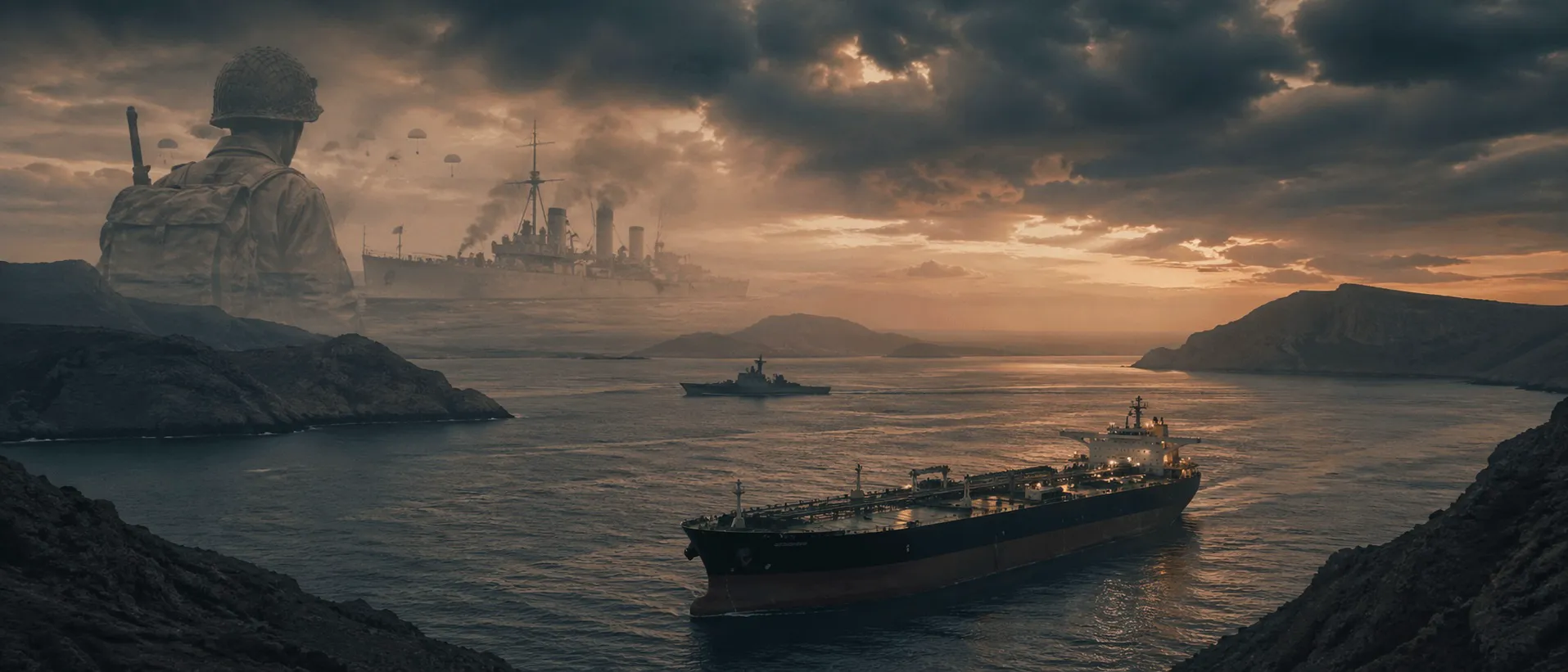
By the first week of November 1956, British paratroopers had taken Port Said. The military assessment was that Anglo-French forces could seize the entire Suez Canal within twenty-four hours. They never got the chance. Eisenhower's Treasury was already preparing to dump American holdings of sterling bonds onto the market. The Bank of England had bled $45 million in reserves between October 30 and November 2. A loan request to the IMF had been blocked in Washington. Harold Macmillan, the chancellor, told his prime minister that the pound could not survive another week of this. On November 6, Anthony Eden accepted a ceasefire. He resigned two months later, broken in body and reputation.
The empire did not end that night, but the bill came due.
Seventy years later, reading the cables about the Strait of Hormuz, I cannot shake the feeling that someone is reading old dispatches aloud in the Oval Office and no one is listening. On February 28, 2026, the United States and Israel launched Operation Epic Fury. Iran's Supreme Leader Ali Khamenei was killed in the opening strikes. Within a week, Iran had effectively closed the Strait of Hormuz, the narrow passage through which roughly a quarter of the world's seaborne oil and a fifth of its liquefied natural gas move on a normal day. Brent crude climbed past one hundred dollars a barrel on March 8, for the first time in four years, peaking at one hundred twenty-six. March 2026 produced the largest monthly increase in oil prices on record. The International Monetary Fund called the shock the biggest disruption to world energy supply since the seventies.
Berlin's Tageszeitung put the thought in print that several analysts have been circling privately. Once again it is about control of a sea route that matters to the whole world. Once again an imperial power has embarked on a military adventure with an uncertain end. What is at stake, the paper argued, is the continuation or the end of America's claim to global primacy.
Historical parallels flatter. They also mislead. The actors are different, the technology is different, and the global balance in 2026 bears almost no resemblance to the bipolar order of 1956. Parallels never predict. But they do clarify the way old photographs sometimes show you what you were looking at without seeing.
What Actually Happened at Suez
The surface reading of Suez in most school textbooks is that Britain and France were stopped by Soviet threats. Nikita Khrushchev did rattle nuclear sabers, suggesting Moscow might rain rockets on London and Paris. That threat made headlines. It did not make policy.
The real blow came from Washington. Eisenhower was furious that Eden had gone to war without telling him, in the middle of a US presidential election, and in a week when Soviet tanks were crushing Hungary. He saw the Anglo-French adventure as a gift to Moscow's propaganda, a distraction that would push Arab states into the Soviet camp, and an embarrassment to American claims of leading a free world against colonial aggression.
So Eisenhower reached for an instrument that no amount of British paratroopers could answer. He ordered the Treasury to prepare to sell American holdings of sterling bonds. He told the IMF that Britain's emergency loan request would be denied until there was a ceasefire. In October 1956, Britain's entire foreign currency reserve was about 2.2 billion dollars. The United States held 3.75 billion dollars in British debt from the 1945 Anglo American Loan. Do the arithmetic. The pound would have collapsed. Macmillan, who later became prime minister himself, told Eden that within weeks of a sterling crisis Britain would be unable to import food and fuel.
An army that could have taken the canal in a day was called home because the currency backing that army could not survive a week. Britain and France discovered that you can win every engagement and still lose the war that matters. The pound lost its crown as the undisputed second reserve currency, a decline that culminated in the 1967 devaluation. Britain never tried anything like Suez again. Three years later, Harold Macmillan was in Cape Town delivering the "winds of change" speech that effectively announced the end of empire in Africa. Britain's own cabinet papers, declassified decades later, describe the Suez experience in language that reads like a man recounting a stroke.
The 2026 Problem
Now look at where the United States has put itself.
The Strait of Hormuz has been effectively closed since late February. A two week ceasefire agreed to on April 7 collapsed within days. On April 18, Iran reimposed restrictions on shipping. Over the weekend that followed, Iranian gunboats fired on tankers, two Indian flagged ships were forced to turn back, and the Safeen Prestige's rescue tugboat was struck by missiles and sank. The US Navy seized an Iranian container ship in the Gulf of Oman on Sunday. No tankers crossed the strait that day. Roughly thirteen million barrels a day of production remains shut in.
The Atlantic Council's tracker shows two of four available US aircraft carriers, the Abraham Lincoln and the Gerald R. Ford, deployed to the Gulf theater with a third, the Bush, rounding the Cape of Good Hope. The 31st Marine Expeditionary Unit was pulled from Japan. Forty eight THAAD interceptors were moved off the Korean Peninsula to support Israeli and Gulf state missile defense. Patriot batteries went with them. Japan based destroyers are in the Arabian Sea. A Marine Expeditionary Unit homeported in San Diego, the 11th, is steaming toward the region as well. One third of the US surface fleet has been repositioned to fight Iran.
The USS George Washington in Yokosuka is under maintenance. For long stretches over the past two months, the US Navy has had no deployable aircraft carrier in the western Pacific. The 19FortyFive defense site put it bluntly last week: most of America's carriers are in Iran, in shipyards, or sailing around Africa, and China knows it.
Satellite imagery from the Asia Maritime Transparency Initiative shows Beijing has scaled up reclamation work at Antelope Reef in the Paracels since October, potentially producing China's largest occupied feature in the South China Sea. US reconnaissance flights over the South China Sea dropped from 102 in December-January to 72 in February. The construction cranes work while the US surveillance aircraft are somewhere over the Arabian Peninsula.
I lived through a smaller version of this pattern once, working on a logistics project for a shipping firm with exposure to Gulf insurance premiums. When the 2019 tanker attacks spiked, everybody wanted dashboards showing hull war risk percentages by the hour. The CFO kept asking the same question, quarter after quarter: "How long before our routes become uninsurable at any price?" That is the question being asked in board rooms from Singapore to Rotterdam right now, except the numbers are worse. War risk ship insurance premiums for the strait jumped from 0.125 percent to between 0.2 and 0.4 percent of hull value per transit before the February strikes. For a VLCC, that is a quarter million dollars extra every time it sails. Major shipping firms suspended operations. That suspension is what an economic blockade looks like when no one has formally declared one.
This is the uncomfortable part of the parallel, and it is the part Washington seems least willing to confront.
In 1956, an outside great power with financial reach, political patience, and a clear strategic interest in seeing the incumbent imperial power humbled used that reach decisively. Moscow threatened. Washington acted. The Americans did not fire a shot. They squeezed a currency out.
In 2026, who will have financial hold over the United States? The answer is not flattering. China holds approximately 759 billion dollars in US Treasuries, down from its 2013 peak but still enough to roil markets if deployed with intent. More to the point, China has accumulated the kind of nonfinancial grip Britain could only dream of denying Egypt: it is the largest trading partner of nearly every country the United States needs to hold together this coalition; it controls rare earth processing chains that run through nearly every advanced American weapons system; and it is, quietly, the largest importer of Iranian oil.
Beijing has been careful. It declared neutrality. It condemned the strikes in language measured enough to preserve diplomatic space. It has not supplied Iran with weapons, at least not that Trump has been willing to confirm, though Iranian missiles have continued to find their targets with a consistency that suggests someone is providing parts and intelligence. Foreign Minister Wang Yi has made twenty six phone calls to counterparts from Saudi Arabia to Germany since the war began. On March 31, China and Pakistan put forward a five point proposal for a ceasefire and resumption of navigation. The African Union praised it as a timely contribution.
That proposal put China's fingerprints on the diplomacy without China ever stepping into the spotlight. Pakistan's army chief, Asim Munir, has acted as the practical channel. Islamabad hosted the talks. Beijing provided political weight. This is precisely the pattern a patient power uses when its rival is self-harming. You do not interrupt. You do not gloat. You position yourself as the reasonable voice while your opponent burns resources in a theater you had already decided to leave behind.
Yun Sun at the Stimson Center made the sharp distinction in Al Jazeera: Pakistan can mediate between the United States and Iran. China cannot. But China can guarantee the deal that Pakistan brokers, and that is the role Tehran has quietly requested. Iran has asked for guarantees. The guarantor is Beijing.
I do not want to press the Suez parallel harder than it will bear. There are two differences that complicate the picture, and honest analysis means naming them.
First, the United States is not Britain in 1956 in the narrow financial sense. The dollar is still the world's reserve currency by a distance that no rival can close in a year or even a decade. There is no equivalent of the sterling bond threat available to Beijing that would not also detonate the value of China's own Treasury holdings. Mutual financial destruction cuts both ways. Nothing in 2026 maps cleanly onto Eisenhower's phone call to Humphrey at Treasury.
But the reserve currency cushion is softer than it looks. The dollar's share of global reserves has drifted from roughly 72 percent in 2000 to about 58 percent today. Gold holdings by central banks outside the G7 have climbed. The BRICS payment infrastructure is slow and clunky, but it exists now, and every month of elevated oil prices gives countries a reason to route around sanctions. Eisenhower's threat worked because sterling was already weakening and the whole world knew it. The dollar is stronger than sterling was. It is not as strong as people in Washington assume. Every sanctioned Iranian barrel that moves through shadow fleet transactions settled outside dollar clearing is a small lesson in alternatives.
Second, the United States is not a colonial power trying to reimpose direct control of a canal. It did not invade Iran to run Iran. The ambitions in 2026 are narrower and in some ways more defensible. Stop a nuclear program. Restore deterrence. Keep a sea lane open. These are not the same as Eden's delusion of bringing back the imperial century.
Does that distinction matter to the tanker captain who is not sailing through Hormuz? It does not. The structural problem for American power is the same problem Britain faced. Military success and strategic failure are not opposites. They can coexist in the same campaign. You can take Port Said and still lose the empire. You can hit every target in Iran and still watch the Strait close.
Chas Eyre, quoted in CNBC this week, told markets what the US negotiating team has refused to absorb. Washington is not focused on negotiation in any serious sense. It is waiting for Iranian capitulation. Until the Americans rid themselves of the misconception that military victory equals strategic dominance, Eyre said, there will be no solution.
That sentence could have been written about Eden's cabinet in November 1956, word for word.
In 1956, Britain and France learned that an army can win every engagement and still lose the war that matters. The question in 2026 is whether the narrowing of what analysts are now calling the carotid artery of global oil and gas trade will produce a stroke to American hegemony. The answer is not knowable from here. I do not pretend otherwise. But the thing worth noticing is who is standing quietly in the waiting room of that possible hospital, unarmed, patient, holding a coffee, and ready to take over the patient's affairs when the time comes.
Seventy years ago, that person was named Eisenhower. They worked out of Washington. They were planning to replace the pound with the dollar and the Union Jack with the stars and stripes across half the globe, and they did.
Who is holding the coffee this time?