The Bone Detective Who Quietly Rewired Science
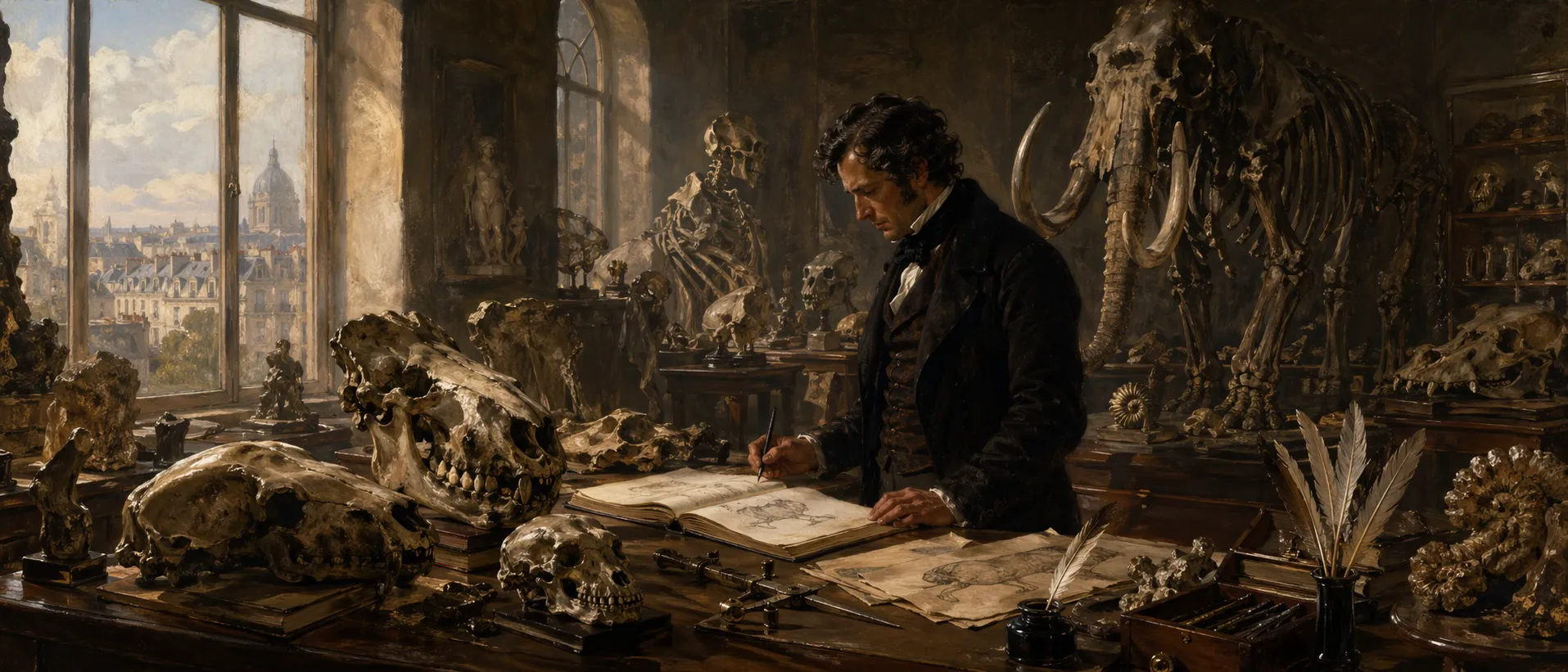
In 1804, a workman in the gypsum quarries of Montmartre handed Georges Cuvier a slab of stone with a small fossilized skeleton embedded in it. Most of the animal was hidden under a rock. Cuvier looked at the exposed bones and, before chiseling further, announced that this was a marsupial. He even predicted that when the rest of the skeleton was uncovered, the pelvis would contain two specific bones found only in marsupials, a feature unknown in any European mammal. He had the rock prepared in front of an audience. The bones were there.
This was not a magic trick, though Cuvier never minded the theater of it. It was a demonstration of a method he had spent years building, and the method itself, more than any single discovery, is the thing that mattered. Cuvier did not invent paleontology so much as he invented a way of looking at organisms that turned them into legible objects. Bones could be read. Tissues could be read. Eventually, by extension, sick bodies could be read. And once that habit of reading took hold among nineteenth century scientists, medicine, biology, and the philosophy of science were never the same.
He was a strange figure to have done all this. Born in 1769 in Montbéliard, a French speaking enclave then ruled by the Duke of Württemberg, Cuvier was a Lutheran from the provinces who somehow served three opposing French regimes (the Revolution, Napoleon, and the restored monarchy) without losing his head, his job, or his appetite. He was made a Baron, a Peer of France, and an inspector general of public instruction. His name is one of the seventy two engraved on the Eiffel Tower. By the time he died of cholera in Paris in 1832, he had effectively built two scientific disciplines from scratch and seeded a third without ever practicing it.
The principle that turned bones into sentences
The center of Cuvier's work is a single idea he called the correlation of parts. The claim, in plain language, is that an organism is not a bag of organs sitting next to each other. It is an integrated system in which every part presupposes every other part. A predator's claw implies a particular kind of jaw. That jaw implies a particular gut. The gut implies a metabolism, the metabolism implies a way of moving, and the way of moving implies a particular skeleton. If you understand the rules, a single bone can tell you the whole animal.
This is what let him do the Montmartre trick. It is also what let him publish, between 1798 and 1812, a series of papers on fossil quadrupeds that established something the eighteenth century had resisted believing. There used to be animals on Earth that no longer exist. The American mastodon, the Irish elk, the giant ground sloth, and the woolly mammoth as a species distinct from any living elephant. Extinction, as a scientific fact, is largely Cuvier's. Before him, even sober naturalists assumed missing creatures were probably still hiding somewhere unexplored. Cuvier compared bones from Big Bone Lick in Kentucky with mammoth bones from Siberia and with skeletons of African and Indian elephants in his museum and showed by morphological analysis that the fossil animals were not lost varieties of living ones. They were gone.
What people miss when they tell this story is how much of the heavy lifting was done not by genius but by method. Cuvier sat in the Museum of Natural History in Paris with one of the largest collections of comparative skeletons assembled anywhere on the planet, much of it brought back on French ships during the Napoleonic period. He compared. Then he compared again. Then he wrote down rules of correspondence between forms and functions. The principle of correlation was the abstract version of what he was actually doing all day with calipers and notebooks.
He was honest, mostly, about the limits. Later historians have pointed out that his predictive successes came less from any elegant universal law of correlation than from the fact that he had personally examined more vertebrate skeletons than anyone alive. The principle was a useful frame; the recognition was pattern matching at industrial scale. Either way, he had built something the field could use.
Why a fossil hunter mattered to physicians
The article you may have read on this topic emphasizes Cuvier's effect on medicine, and it is right to. He never treated a patient. He probably never wanted to. But the way he taught a generation of French scientists to look at bodies bled directly into the medical schools of Paris during the same decades, and the result was a transformation that medicine had not managed in centuries.
Consider what medicine looked like in 1790. A physician examined a patient by asking what was wrong. The answer, in Foucault's neat phrasing, was a list of symptoms: fever, pain in the side, a bad cough, and weakness in the limbs. These were arranged into nosological categories, often borrowed from botanical taxonomy, with diseases classified by their visible signs the way Linnaeus classified plants by their petals. The body itself was a kind of stage on which symptoms appeared. Where the symptoms came from inside the body was treated almost as a secondary question.
Then, in the late 1790s and early 1800s, in the same Paris where Cuvier was reconstructing extinct mammals from teeth, a young surgeon named Xavier Bichat began arguing that the proper unit of pathological analysis was not the symptom and not the organ but the tissue. He distinguished twenty one different tissue types and proposed that disease was a modification of these tissues, visible in the dead body if you bothered to open it up. The famous instruction comes from his Anatomie Générale of 1801, where he tells students who have spent twenty years taking notes at bedsides only to face incoherent symptoms: open up a few corpses and the darkness will dissipate.
Bichat is properly the father of histology, and you can find him in any decent history of medicine. What gets less attention is how naturally his approach fit into the conceptual furniture Cuvier had been arranging in the same city. Both men assumed the body was an integrated functional system. Both assumed function was inseparable from structure. Both assumed that to understand something, you had to compare it carefully against many other examples and find the patterns. Bichat, who died at thirty one after falling down a staircase at the Hôtel Dieu, did not need to read Cuvier to think this way. The way of thinking was in the air, and Cuvier was one of the people putting it there.
The next generation made the connection explicit. By the time Jean Martin Charcot was running the Salpêtrière in the 1860s and 1870s, French neurology had become a discipline built almost entirely on the correlation between clinical observation of living patients and anatomical findings at autopsy. Charcot would watch a patient's gait for months, document the tremors, then dissect the brain after death and locate the lesion. This is the anatomoclinical method, and it is the medical descendant of comparative anatomy. The lineage runs Cuvier, Bichat, Laënnec, Charcot, with branches into every modern specialty that uses imaging to localize disease.
The trick of inventing the normal
There is a subtler thing Cuvier did that I think gets undersold. By comparing thousands of organisms, he made it possible, for the first time, to define what was normal as a statistical and structural concept rather than as a Platonic ideal or a theological one.
Before this kind of systematic comparison, the normal form of an animal or an organ was either an essence (the kind of thing Aristotle would have recognized) or a divine intention. After Cuvier, the normal became something you could derive empirically by looking at a great many examples and noting the recurring patterns. Variation became measurable. Deviation became visible. Pathology, as a concept, requires this. You cannot have a coherent idea of disease as structural deviation from a norm if you do not first have a norm built out of comparisons.
This is why Michel Foucault, in The Birth of the Clinic, reaches for Cuvier when he describes the epistemological shift that produced what he calls the medical gaze. Foucault is not saying Cuvier handed Bichat a manuscript. He is saying that a particular way of producing knowledge, in which the individual body becomes legible as an instance of general patterns, emerged across natural history and medicine at the same moment because the same logic was driving both. Cuvier provided the cleanest, most articulate version of that logic anyone had yet written down.
A small example of how durable this is. Modern radiology is built on it. When a radiologist looks at a CT scan, what she is doing is comparing the image in front of her against an internalized library of normal anatomy and recognizing the deviation. The principle of correlation is also there: If a particular structure looks wrong in one place, the radiologist knows which adjacent structures to check because the body is read as a system in which parts presuppose each other. None of this would feel obvious to a physician of 1780. It feels obvious now because Cuvier and his successors made it the default.
Where he was wrong, and why it still matters
Cuvier was not always right, and some of his errors were important. He insisted, against his colleague Jean Baptiste Lamarck and later against his old friend Étienne Geoffroy Saint Hilaire, that species do not change. His argument was internally consistent: if every organism is a tightly integrated functional whole, any significant change in one part would destroy the balance and kill the animal. The mummified cats and ibises that French soldiers brought back from Napoleon's Egyptian campaign, three thousand years old and morphologically identical to living specimens, seemed to clinch the point. Things stay the same. Extinction is real, but evolution is not.
He won the public debate with Geoffroy in 1830, which was conducted in front of the Académie des Sciences and watched closely across European intellectual life. Goethe wrote about it. Cuvier had the better data and the more rigorous argument and the more imposing presence. He was also wrong in the sense that mattered most. Within thirty years of his death, Darwin had shown that the integrated functional whole could change, slowly, through accumulated variation and selection. The Egyptian cats just had not had enough time.
But here is the thing worth noticing. Even Darwin needed Cuvier's method to do his work. The Origin of Species rests on comparative anatomy, on the recognition of homologies between species, and on the reading of fossils as evidence of past forms. Darwin used Cuvier's tools to argue against Cuvier's conclusions. This is, in a way, the strongest possible vindication of a method: when your enemies have to use it to beat you.
The same is true in medicine. Cuvier's specific commitments (functional fixity, divine teleology, and a Kantian flavor of internal purpose) have been quietly discarded. His method, the trained habit of comparing structures, identifying functional relationships, distinguishing normal patterns from deviations, and using one piece of evidence to predict the rest, is still the operating system of every clinical specialty and most of biology.
A man who never wrote a prescription
There is something almost funny about the shape of Cuvier's influence. He was a paleontologist. He spent his life with bones, mostly dead and mostly very old. He had no particular interest in living patients and would have made, by all accounts, a terrible bedside doctor. He was reportedly cold, ferociously hierarchical, and willing to crush academic rivals with the institutional power he had accumulated. Geoffroy Saint Hilaire, who had brought him to Paris in 1795 and been his closest collaborator for years, ended up on the receiving end of that power.
And yet the way doctors today think about disease (as something localized, structural, visible in tissue, and definable as a deviation from a comparative norm) is closer to how Cuvier thought about a fossil jaw than to how any physician of his own era thought about a fever. The clinical case presentation, with its movement from observation to inference to localization to confirmation, is recognizably the same intellectual procedure he used at Montmartre.
When a neurologist looks at an MRI and says the lesion explains the deficit, that is Cuvier. When a pathologist matches a tissue sample to a known disease pattern, that is Cuvier. When a medical student is told that anatomy precedes pathology because you cannot recognize the abnormal until you know the normal cold, that is Cuvier, even if the student has never heard the name.
The quarry workers at Montmartre eventually got used to him. When they found something interesting, they sent for the Baron. He would arrive, look, and pronounce. Sometimes he was theatrical about it. Sometimes he was just right.