A Pair of Supermassive Black Holes Are Locked in a Final Spiral, and Earth Will Hear the Crash
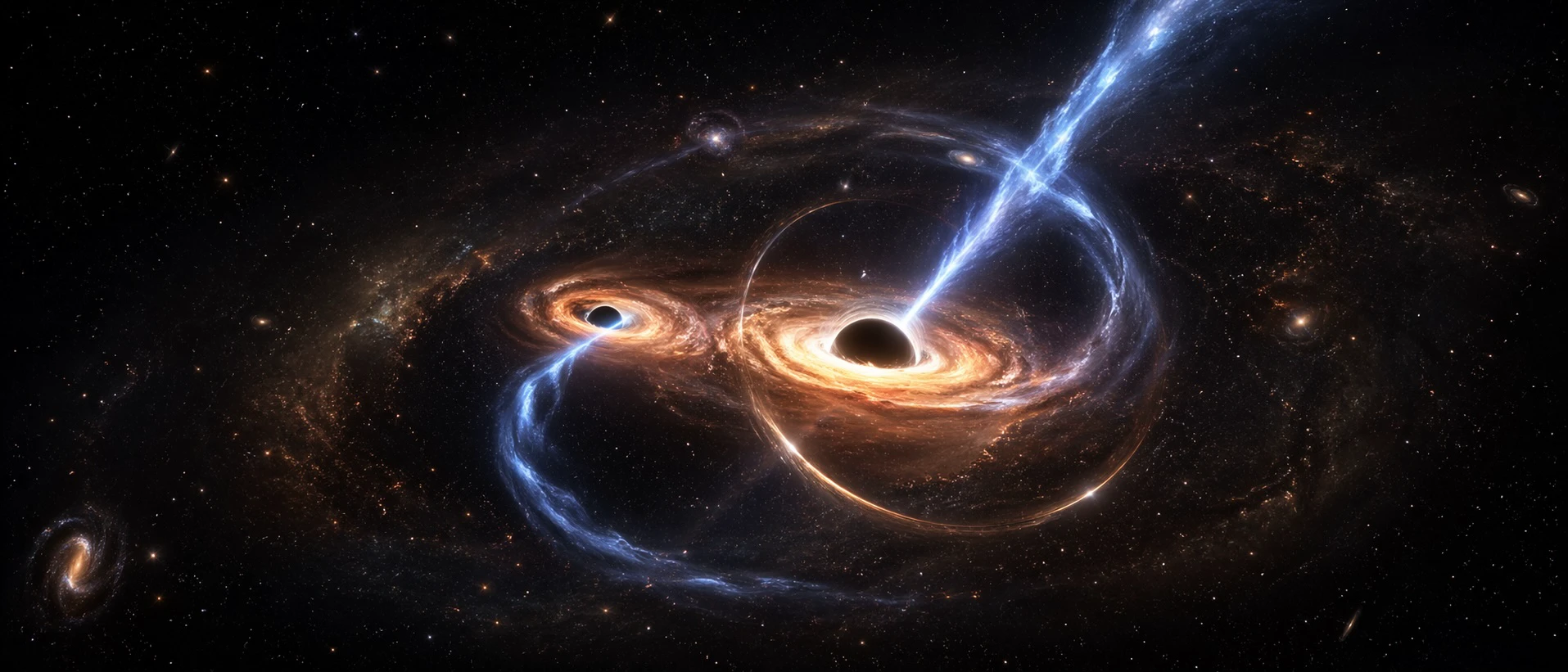
Twenty three years of stubborn radio observations finally cracked open something astronomers have hunted for decades. At the heart of Markarian 501, a galaxy in the constellation Hercules sitting about 500 million light-years from Earth, there are not one but two supermassive black holes. They are circling each other every 121 days, separated by a distance only a few hundred times wider than the gap between Earth and the Sun, and they are on a track that ends in collision. The merger could happen within the next 100 years.
That timeline is what makes the discovery jaw-dropping. Mergers of supermassive black holes have been theoretical staples for half a century. Every model of galaxy evolution requires them. Galaxies eat each other constantly across cosmic time, and the black holes at their centers are supposed to sink toward the new combined center, pair up, and eventually fuse into something even more massive. The math demands it. The observational evidence has been embarrassingly thin. Until now, nobody had caught a close binary pair red-handed in the final stretch before they smash together.
The team led by Silke Britzen at the Max Planck Institute for Radio Astronomy in Bonn changed that. Their paper, published in Monthly Notices of the Royal Astronomical Society, lays out the case using more than 80 separate observations from the Very Long Baseline Array, a network of ten radio telescopes spread across North America from Hawaii to the Virgin Islands. The data spans 23 years and several radio frequencies, and it shows something that should not exist if Markarian 501 contained a single black hole: a second jet, distinct from the main one, swinging counterclockwise around the galactic core in a pattern that only makes sense if a second engine is producing it.
How a blazar gave up its secret
Markarian 501 has been famous in astrophysics circles since the 1990s for being one of the brightest sources of very-high-energy gamma rays in the sky. It is a blazar, which is the technical name for an active galactic nucleus that happens to be pointing one of its relativistic jets nearly straight at us. Most of the time, when you look at a blazar, you are looking down the barrel of a particle gun aimed at Earth. The brightness gets amplified enormously by relativistic effects, which is why Markarian 501 punches so far above its weight despite being half a billion light-years away.
For a long time the assumption was simple. One galaxy, one supermassive black hole, one jet. The numbers worked. Then the jet started misbehaving.
Britzen and her colleagues kept noticing that the jet was not pointing in a consistent direction. Over years, the orientation drifted in ways that a single static black hole should not produce. The angle of the jet wobbled. Knots of plasma traveled along trajectories that did not match a clean straight outflow. Something was making the entire system sway.
When they pulled together the long baseline of high-resolution imaging and looked at the central region carefully, the second jet emerged. It was always there in the data, hidden under the brightness of the main jet, but the patterns over time gave it away. The second jet starts behind the larger black hole and arcs counterclockwise around it. The cycle repeats. Britzen described the experience of analyzing the data as feeling like being on a ship, with the entire jet system in constant motion. A binary system explains that motion neatly. A single black hole does not.
Each of the two black holes weighs somewhere between 100 million and one billion times the mass of our Sun. The lower bound is already absurd. The upper bound puts each one in the same ballpark as the largest known black holes in the local universe. They are separated by 250 to 540 astronomical units, where one astronomical unit is the distance from Earth to the Sun, roughly 93 million miles. To put that in perspective, Pluto sits at about 40 astronomical units from the Sun. These two black holes are crammed into a space only a few times bigger than the orbit of Pluto, and each one weighs as much as an entire small galaxy.
That kind of proximity, between objects of that mass, is what astronomers call the final parsec. It has been a theoretical headache for years. Models can get supermassive black holes close together through galaxy mergers and dynamical friction with surrounding stars and gas, but at a separation of about a parsec, roughly 3.26 light-years, the mechanisms that drive them inward run out of fuel. They should stall. Yet the existence of the gravitational wave background detected by pulsar timing arrays in 2023 suggests that they do not actually stall. Something pushes them through. Markarian 501 may be the first system caught in the act of doing exactly that.
The Einstein ring that gave it away
In June 2022, the geometry of the system briefly snapped into a configuration that nature almost never grants. The two black holes lined up along our line of sight so precisely that the gravity of the foreground black hole bent the radiation from the background black hole's jet into a near-perfect circle. An Einstein ring.
Einstein predicted these in 1915 as a consequence of general relativity. Mass curves spacetime, and light follows the curves. When a massive foreground object sits between you and a background source with perfect alignment, the light from the background source gets smeared into a ring around the foreground mass. Most Einstein rings observed today involve entire galaxies acting as the lens. Seeing one form within a single galactic nucleus, produced by one black hole lensing the jet of another, is something else entirely.
For Britzen and her team, the ring was the receipt. Two independent indicators now pointed to the same conclusion. The wobbling jet behavior could in principle have other explanations, even if they were strained. The Einstein ring requires a second compact massive object behind the first one, which is exactly what the binary model predicts. As Britzen put it bluntly, the binary model provides a self-consistent solution, and since the jets are pointed at us, an Einstein ring is exactly what you would expect to see when the orbit brings the two objects into alignment.
This is the kind of evidence that is hard to argue with. You can debate jet morphology for decades. A geometric prediction confirmed by an observation either holds up or it doesn't. This one held up.
When 100 years is just around the corner
The merger timeline depends on the actual masses, which still carry significant uncertainty. The lower mass estimate stretches the merger out by tens of thousands of years. The higher mass estimate squeezes it into roughly a century. Either way, on the timescales that matter to astronomy, this is happening now. A galaxy that took ten billion years to evolve is about to undergo its single most violent event in the lifetime of someone alive today, or at most their great-grandchildren.
Here is what makes that statement strange. The collision itself already happened, in the only sense that matters for our experience of it. Markarian 501 is 500 million light-years away. Whatever we see of it now is what was happening 500 million years ago, when life on Earth was still figuring out how to climb out of the ocean. When astronomers say the merger will occur within 100 years, they mean within 100 years of when the light reaches us. The actual gravitational shockwave from the collision will then take another 500 million years to arrive at any other observer in the universe positioned to notice. From our vantage point, the cosmic clock is set so that we get to watch the inspiral and the merger in real time, even though both events lie deep in the cosmic past.
The waves themselves are nothing like what LIGO detects. LIGO and its sister observatory Virgo measure gravitational waves from stellar-mass black hole mergers, where two objects each weighing a few dozen solar masses spiral together in a fraction of a second and produce a sharp chirp at audio frequencies. Supermassive black hole binaries operate on a completely different scale. The Markarian 501 system would emit gravitational waves at nanohertz frequencies, oscillations that take months or years to complete a single cycle. These are the slow, deep undulations of spacetime that pulsar timing arrays are designed to catch.
In 2023, four independent collaborations, NANOGrav in North America, EPTA in Europe, the Parkes array in Australia, and the Chinese pulsar timing array, all reported evidence of a gravitational wave background at exactly these frequencies. The interpretation favored by most researchers is that the background hum is the combined noise of every supermassive black hole binary in the observable universe slowly grinding toward merger. Markarian 501 changes the game because it offers a specific, locatable source. Instead of measuring the integrated whisper of countless distant binaries, the pulsar timing arrays can now tune their search toward one known coordinate in the sky.
If the strain signal from Markarian 501 rises above the background noise as the orbit decays, we will witness something nobody has ever seen. The frequency of the gravitational waves will steadily increase as the two black holes spiral closer. We will hear the pitch climb, slowly over years and decades, until the final plunge produces a signal of unimaginable amplitude.
I keep coming back to one detail from Britzen's account of the discovery. When she realized the second jet was real, her reaction was not the polished academic response. She told the BBC that her thought was, "That's how it works?" She was so amazed and overwhelmed that she wanted to tell everybody what they had just found. There is something refreshing about a senior researcher at one of the world's top astrophysics institutes reacting to her own discovery the way a child reacts to seeing a magic trick. Sometimes the universe genuinely surprises the people who study it for a living.
The Event Horizon Telescope, the array that gave us the first images of black holes in 2019 and 2022, cannot resolve the two objects in Markarian 501 as separate points. The angular separation is too small at that distance. Even the best radio interferometry on Earth has to infer the binary geometry from secondary effects rather than imaging the system directly. But the gravitational wave signal will not need a telescope to image anything. It will pass through Earth, through every detector we build, and through every pulsar in the galaxy, and the timing data will tell us exactly what happened. Spacetime itself will deliver the message.
A merger of two black holes weighing nearly two billion solar masses combined will be the most energetic single event humanity has ever measured. The peak power output, for a fraction of a second, will exceed the combined light output of every star in the observable universe. That is not a metaphor. That is the actual physics. Gravitational radiation carries away energy with terrifying efficiency when objects of this mass coalesce, and the equations of general relativity predict outputs that dwarf anything else.
What will we learn? Probably an answer to the final parsec problem, which has nagged theorists for two decades. We will get the cleanest test of general relativity in the strong-field regime, where gravity behaves in ways that have never been directly probed. We will see whether the predicted ringdown waveform of the merged remnant matches the Kerr metric for a rotating black hole or whether something unexpected emerges. The merger remnant in Markarian 501 will be one of the largest black holes ever measured, with a mass approaching two billion times that of the Sun, and the formation of such a beast in real time will tell us how the largest black holes in the universe got that big.
The two giants in Markarian 501 do not know we are watching. They have been doing this dance for millions of years, and they will keep doing it whether or not anyone on a small wet planet in a backwater spiral galaxy has the ability to detect it. But we do have that ability, and the timing is almost suspicious. We figured out gravitational waves exist a hundred years ago. We built the detectors to find them in the last decade. We caught the first close binary supermassive pair a few years after that. And now we get to watch one merge.
If Britzen and her team are right about the timeline, somebody alive today might still be around to read the pulsar timing data on the day Markarian 501's final chirp arrives. That is not a guarantee; the merger could land anywhere in a century or more, and the full gravitational wave signature will take additional decades to analyze. But the possibility exists. A black hole merger you can watch in your lifetime, predicted in advance, with the source already named and located. The universe does not usually offer this kind of preview.