Brussels Bets €200 Million on Reactors That Don't Exist Yet. Here's Why That's a Mistake.
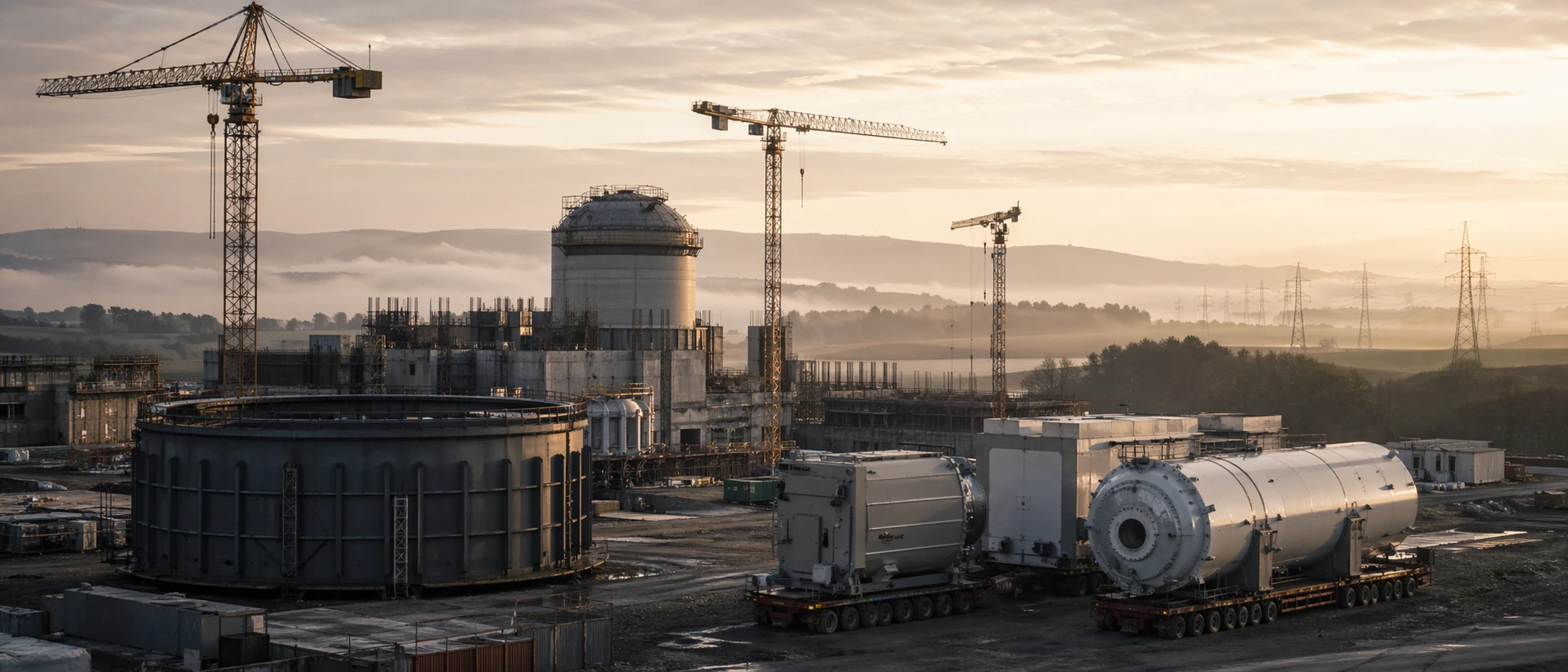
The European Commission published its Small Modular Reactor strategy on 10 March 2026 with the kind of confident language that should make anyone who has watched a nuclear project unfold over the last twenty years wince. First European SMRs by the early 2030s. A capacity range of 17 to 53 gigawatts by 2050. An InvestEU top-up of €200 million in de-risking guarantees, plus a slice of the European Investment Bank's promised €75 billion in energy transition financing over the next three years. The Eighth Nuclear Illustrative Programme estimates €241 billion in nuclear investments through 2050, with SMRs and Advanced Modular Reactors needing yet more on top of that.
Big numbers. Bigger promises.
I want to be careful here, because the easy thing to do is dunk on nuclear from either side. The pro-nuclear camp treats every new SMR press release like a victory lap. The anti-nuclear camp acts as if Three Mile Island happened last week and renewables alone can run a steel mill. Both are wrong, and both are unhelpful when the EU is actually about to spend serious public money.
So let me be direct about where I land. The EU's renewed interest in nuclear isn't crazy. The specific bet is on SMRs as the savior of energy security.
The numbers nobody in Brussels wants to talk about
In November 2023, NuScale and the Utah Associated Municipal Power Systems killed what was supposed to be the first commercial SMR plant in the United States. The project had been running since 2014. By the time it died, the per-megawatt-hour cost had crept from around $58 in initial estimates to $89, and the total project cost had ballooned past $9.3 billion for 462 megawatts of generation. The U.S. Department of Energy had already sunk $232 million into it as part of a $1.4 billion cost-share agreement. The reactor design had to be uprated from 50 to 77 megawatts per module just to chase the rising marginal cost. None of it worked.
NuScale, for the record, is the only U.S. company with a Nuclear Regulatory Commission-approved SMR design. They are the success story of the sector. And their first commercial customer walked away because the math stopped making sense.
Now look at what the European Commission is actually proposing. €200 million in de-risking guarantees. That's the new SMR-specific money. To put that in context, the cancelled Utah project was already $9.3 billion when it died, and that was before construction started. The Hinkley Point C reactor in the UK, a conventional large-scale plant, is currently estimated at around £46 billion for 3.2 gigawatts. The financial scale Brussels is talking about is somewhere between optimistic and decorative.
The Commission knows this. The €200 million is meant to "mobilize private capital." That language is doing a lot of work. What it actually means is: "We will absorb a small fraction of the early losses if private investors agree to absorb the catastrophic ones." Private investors have been looking at SMR economics for fifteen years now and have largely concluded that those losses are not worth absorbing without much heavier government backing. This is why the Heinrich Böll Foundation's February 2026 brief noted that no SMR concept had been granted a construction license anywhere in the EU at the time of writing.
The eight projects the European Industrial Alliance is tracking, Nuward, the European BWRX-300, the Rolls-Royce SMR, CityHeat, NuScale VOYGR in Romania, EAGLES, the European LFR-AS project from newcleo, and Thorizon One, span at least five fundamentally different reactor technologies. Light water, high-temperature gas-cooled, lead-cooled fast, molten salt. Each of these requires its own supply chain, its own fuel cycle, its own waste management approach, and its own regulatory framework. The whole pitch of "modular" was supposed to be that you build one design over and over and ride the learning curve down. Eight different designs across one alliance is the opposite of that.
The argument that almost works
There is one piece of the pro-SMR case that I find genuinely difficult to wave away, and it has nothing to do with energy security or fighting climate change in the abstract. It's data centers.
European electricity demand from data centers is climbing fast. Ireland's data centers consumed 17% of national electricity in 2022 and the IEA forecasts that share will hit 32% by 2026. The European Data Centre Association expects roughly 15% annual growth in data center electricity demand across Europe through the end of the decade, with a $114 billion investment pipeline. AI inference workloads, which are latency-sensitive and need to sit close to users, are about to overtake training workloads as the dominant load. NVIDIA's GB200 NVL72 racks pull 120 to 140 kilowatts each, and modern AI campuses are sized at 100 to 750 megawatts per site.
The IEA reported earlier this month that the global pipeline of conditional offtake agreements between data center operators and SMR projects has grown from 25 gigawatts at the end of 2024 to 45 gigawatts now. That's not nothing. Hyperscalers have signed enough paper that, if even a fraction converts to firm contracts, SMR developers have a customer base that didn't exist when NuScale was begging utilities to commit.
The problem is the timing. Data centers need power now. SMR developers are talking about early 2030s deployment, and that's the optimistic version. Microsoft's Three Mile Island restart will deliver 835 megawatts in 2027 from a reactor that already exists. Meta's deal with Oklo for a 1.2 gigawatt campus in Ohio sees first power around 2030, with early site work just beginning. The grid in much of Europe cannot wait that long, which is precisely why so much new hyperscale capacity is being built next to natural gas turbines instead. Sightline Climate found that up to 11 gigawatts of data center capacity expected for 2026 is stuck in the announced phase, with half of global projects delayed by power constraints.
Here's where I'd actually push back on my own skepticism. If you're building a data center that needs to run for thirty years, signing a 20-year off-take agreement with an SMR developer to come online in 2032 is a perfectly rational hedge. You'll bridge with gas or grid power until then. The SMR is your decarbonization play for the back half of the asset's life. From a hyperscaler's balance sheet perspective, this works.
The question is whether European public money should subsidize that hedge. The hyperscalers signing those offtake agreements, Amazon, Google, Microsoft, and Meta, are among the richest companies in human history. Their combined capex on AI infrastructure topped $400 billion in 2025, and the IEA expects another 75% increase in 2026. They do not need a €200 million de-risking guarantee from the European taxpayer to motivate a power purchase agreement.
Where the strategy actually breaks down
The real flaw in the EU strategy is that it conflates two completely different problems and proposes one solution for both.
Problem one is European energy security. After Russia's invasion of Ukraine and now the Iran disruption, member states want to stop being held hostage by gas suppliers. This is a real and urgent problem. The fastest, cheapest answers to it are continued renewables buildout, much more grid storage, demand-side flexibility, and yes, lifetime extension of existing nuclear plants. France runs about 67% nuclear and gets reliable carbon-free baseload from it. Keeping French reactors running and finishing the EPR builds at Flamanville and elsewhere is straightforwardly useful. SMRs do nothing for this problem in the time frame that matters, because they don't exist yet.
Problem two is industrial decarbonization, particularly for steel, chemicals, cement, and large data centers that need both reliable power and process heat. This is where the SMR pitch has the most internal logic and where Malvina Kvist of the Clean Air Task Force is right that flexible industrial heat is genuinely hard to deliver from renewables alone. But it's also a problem where you can't credibly claim solutions in 2030 will move the needle, because Europe's heavy industry is already shedding capacity to North America and Asia in 2026. The chemical plant that closes in Ludwigshafen this year isn't waiting for a Rolls-Royce SMR in 2032.
By trying to sell SMRs as the answer to both problems, the Commission ends up overstating their relevance to the first and underestimating how late they are for the second. This is how you end up with strategy documents that promise 17 to 53 gigawatts by 2050, a range so wide it's essentially meaningless, and treat the gap between best and worst case as a planning detail rather than the entire question.
There's also a quieter issue in the Commission's own documents that nobody is highlighting. The most advanced "European" SMR projects are, in several cases, based on non-EU designs. The Romanian project uses NuScale's VOYGR. The Polish projects under negotiation lean on GE Hitachi's BWRX-300. Rolls-Royce is British. Even Nuward, EDF's flagship, has had its development path repeatedly restructured. The Commission's own strategy document acknowledges this and frames "developing a balanced and mutually beneficial" relationship with non-EU vendors as a goal. In practice, what the EU is being asked to fund is at least partly the European deployment of American and Asian reactor designs, with the European value-add concentrated in construction, operation, and supply chain components rather than the core reactor technology itself. That might still be a defensible industrial policy, but it isn't the Airbus-style sovereign capability story Brussels likes to tell.
I worked through the Eighth PINC document line by line a few weeks ago. The gap between what large-scale lifetime extension and new EPRs can deliver, with reasonably well-understood economics, and what SMRs are projected to deliver, with economics that range from "uncertain" to "fictional," is striking. The €36 billion for lifetime extensions through 2050 is the single highest-confidence investment in the entire program. Every euro spent there has a known return. Every euro spent on first-of-a-kind SMR demonstrators is, statistically speaking, a coin flip with a five-year option attached.
The Söder problem
Markus Söder, the Bavarian Prime Minister, has been the loudest voice in Germany pushing for SMR deployment. His pitch is essentially that Germany made a catastrophic mistake by phasing out nuclear and that SMRs are the way back. The first half of that claim is debatable. The second half is fantasy.
Germany decommissioned its last reactors in 2023. Restarting them would take years, cost tens of billions, and require regulatory approvals that would be politically explosive. Building new SMRs in Bavaria, even on the optimistic Commission timeline, means first power somewhere around 2034 if you start the licensing process tomorrow and nothing goes wrong. Nothing ever goes wrong on schedule with new nuclear designs.
Meanwhile, Bavaria's actual energy problem is that it doesn't have enough north-south transmission capacity to import wind power from Schleswig-Holstein and offshore. That's a grid problem, fixable in five years with sufficient political will and a few billion euros. The SMR pitch is, functionally, a way to avoid building those transmission lines by promising local generation instead. It's an argument I'd respect more if anyone making it was honest about the trade.
The fact that politicians find SMRs attractive precisely because they sound modern and don't require building visible high-voltage corridors through scenic Bavarian valleys should tell you something about whose interests are being served by the framing.
What Brussels should be doing is something less exciting and more useful. Pour money into grid infrastructure and storage. Aggressively extend the operating lives of existing French and East European reactors. Maintain a smaller, more focused R&D program on two or three of the most promising SMR designs, probably Nuward and Rolls-Royce, rather than spreading thin support across eight competing technologies. Wait to see whether the first commercial SMRs in Canada, Romania, and the UK actually deliver on their economic promises before committing to fleet deployment. If they do, scale up. If they don't, the money saved will buy a lot of batteries.
That's not a heroic European industrial policy. It won't get a launch ceremony with Ursula von der Leyen at a nuclear summit. But it's the version of the policy where, ten years from now, somebody actually has lights on and a steel plant still running in Duisburg.
The press release version of the SMR strategy reads like a confident bet on a technology Europe is going to lead. The actual document reads like a hedge dressed up as conviction. €200 million in de-risking guarantees against a €241 billion program is a rounding error. It's the smallest amount of money the Commission could plausibly allocate while still claiming to take SMRs seriously. Which suggests that, on some level, the people writing the strategy already know what the engineers and accountants on the Utah project learned in 2023.