The Internet Stopped Being Fun, and We Know Exactly When It Happened
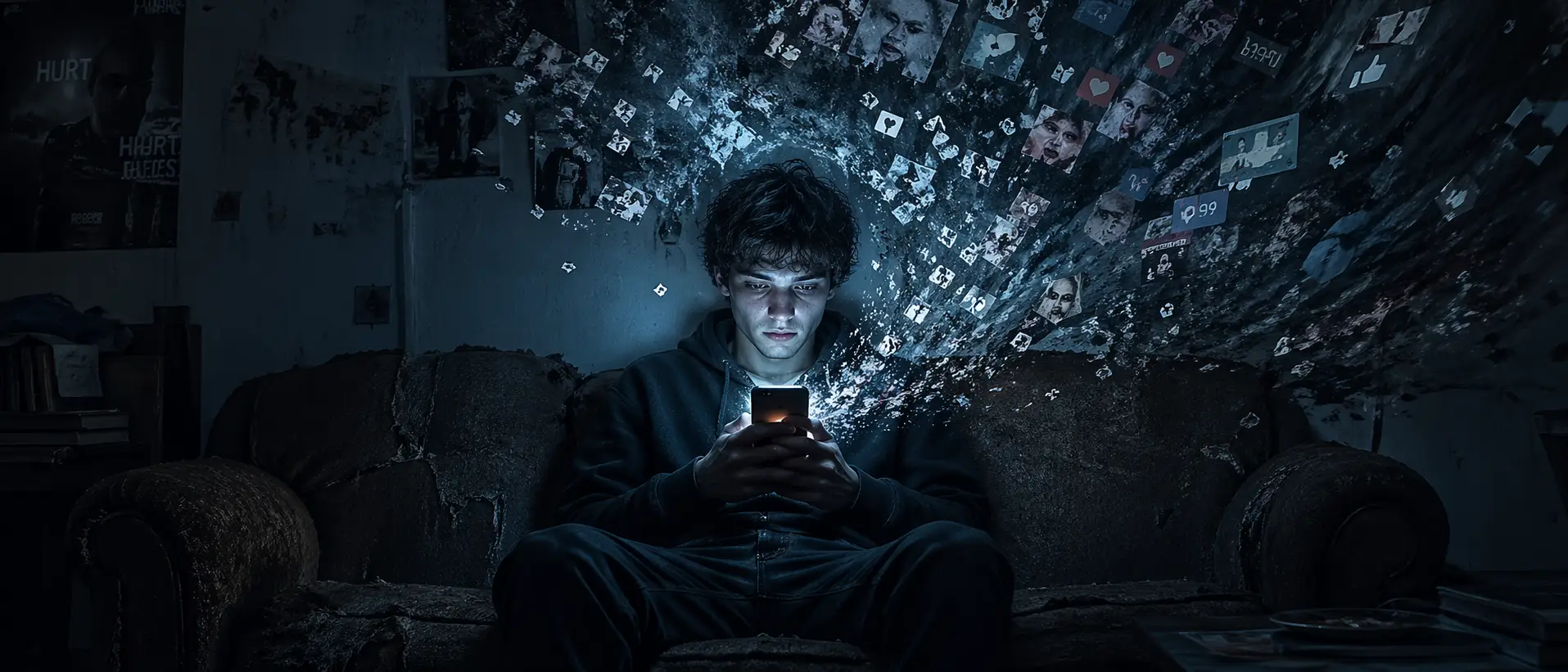
I open Instagram to check a message. Forty minutes later I am watching a stranger in Bulgaria narrate the assembly of a tactical pen, an ad for protein powder I will never buy, a clip from a movie I have never heard of, and a meme about a celebrity feud I cannot follow because I do not know either celebrity. I did not ask for any of this. I did not even consciously choose to keep watching. My thumb just kept moving, and the app kept feeding.
If this sounds familiar, congratulations: you are using the internet correctly, by which I mean the way it has been engineered to be used. The product is working as intended. The intention, however, is not yours.
There is a tendency to discuss the decline of the internet as if it were a mood, a vibes shift, or a generational nostalgia. I think that framing lets the actual culprits off the hook. The internet did not drift. It was redesigned. We can pinpoint when, by whom, and for what reason, and pretending otherwise treats a corporate strategy as if it were weather.
The slow death of the chronological feed
Cast your mind back, if you can, to roughly 2010. Facebook still showed posts in the order they were posted. Twitter was the same. If you followed a hundred people, you saw what those hundred people wrote, top to bottom, with no editorial intervention. The platform was a pipe, not a chef.
This was, from a business standpoint, a disaster. Pipes are boring. Pipes do not maximize engagement. If the people you followed had nothing interesting to say on a given day, you closed the app and went outside. Facebook, watching its quarterly metrics, decided this would not do.
The introduction of EdgeRank and its successors changed the underlying contract. Posts began to be ranked, scored, promoted, and suppressed. The feed stopped being a record of what your network had said and became a curation of what the platform thought would keep you scrolling. By 2016, Twitter and Instagram had followed. The chronological timeline became an opt-in setting buried three menus deep, the way restaurants put the salad on the back page.
The trade was clear even then, although it was rarely described honestly. You gave up control over what you saw in exchange for a feed that was, on average, more entertaining per scroll. The platforms gave up the simple "social network" framing in exchange for ad inventory that performed better. Engagement went up. Time on app went up. Revenue went up.
Something else went up too, although nobody at the companies seemed eager to mention it: the proportion of your feed that came from people you did not know and had never chosen to hear from. The "social" in "social network" started to wilt.
Then TikTok arrived, and the wilt became a clear cut.
TikTok did something the older platforms had been edging toward but never committed to: it abandoned the social graph entirely as the primary engine of distribution. The For You page does not care who you follow. It cares what holds your attention. The system runs a brutally efficient experiment on every video, showing it to a small batch of users, measuring how long they watch, how many rewatch, how many share, and then either promoting it or burying it. Repeat across a billion videos and a billion users, refresh continuously, and you have built the most sophisticated dopamine-extraction machine in human history.
The numbers are not subtle. A 2024 field study at TikTok had 88 users switch off the personalized You feed and use a less personalized one for a week. Daily screen time dropped by 40 minutes. The app opens, dropping by five per day. Self-reported enjoyment fell. The personalization is doing essentially all the work. Strip it away and people lose interest within hours.
Every other major platform watched this happen and concluded, sensibly from a profit standpoint, that they had no choice. Instagram launched Reels. YouTube launched Shorts. Facebook bolted a "For You" tab onto its home screen. Twitter, now X, made the algorithmic timeline the default and made the chronological one harder to find. By 2024, the dominant mode of the internet was no longer "see what your friends posted" or even "see what people you chose to follow are saying." It was "watch what the algorithm thinks will keep you here for nine more seconds."
This is not a small change. This is a different product wearing the old product's clothes.
What gets lost when an algorithm picks for you
The defense of algorithmic feeds, when anyone bothers to make one, usually runs like this: the algorithm shows you what you actually like, even if you did not know you liked it. Your stated preferences, expressed through the people you chose to follow, are noisy and inefficient. The machine knows better.
There is a sliver of truth in this. The algorithm is genuinely good at predicting what will hold your attention for the next nine seconds. The problem is that "what holds your attention for nine seconds" is not the same as "what you enjoy," let alone "what enriches your life." Slot machines hold attention. Car crashes hold attention. A man getting hit in the testicles holds attention. Optimizing for the metric is not the same as optimizing for the goal.
A decent test: when you finish a long scrolling session, do you feel good? Refreshed? Connected to anyone? Most people, if they are honest, feel slightly hollow, vaguely irritated, and a little embarrassed about how much time has passed. That feeling is not a bug. It is the residue of a transaction in which you traded an hour of your life for a sequence of micro-stimulations that added up to nothing.
The original quote in the source material I am thinking about compares scrolling to nicotine, which "gives you no joy" and "is defined entirely by the lack and by the interruption of the lack." That comparison is closer to literal than metaphorical. The behavioral pattern of compulsive checking, brief relief, mounting unease, and renewed checking is the same loop a smoker runs through every twenty minutes. The thing being scrolled is almost incidental. It is the loop that has you.
Recent research keeps arriving at versions of the same finding. A 2025 study published in JAMA, led by researchers at Weill Cornell Medicine, followed thousands of children over four years and found that total screen time at age ten was not associated with worse mental health outcomes. What was associated, strongly, was the development of addictive patterns of use, the inability to stop, distress when the device was taken away, and using the screen to escape. Kids in the high-addictive-use trajectories had two to three times the risk of suicidal behaviors compared to low-use peers. The damage is not in the hours. The damage is in the loop.
A separate Australian study tracking 3,205 adolescents found that passive scrolling, specifically, had the strongest negative association with mental well-being, more than active behaviors like messaging or posting. Passive scrolling is what algorithmic feeds are designed to maximize. It is the entire point.
I do not think this is coincidence, and I do not think the platforms do either. They run their own internal research. Some of it has leaked. Frances Haugen's documents from Facebook in 2021 showed the company knew Instagram made teenage girls feel worse about themselves and shipped the product anyway because the engagement metrics were too good to pass up. There is no reason to believe TikTok's internal calculus is any different. There is no reason to believe Meta's has changed.
The choice was made. The choice continues to be made every quarter. The product is the way it is because it makes more money this way.
A small rebellion that mostly failed
People are not stupid. They notice. There has been, over the past few years, a visible movement of people trying to opt out, or at least to negotiate better terms.
Substack picked up steam by promising writers a direct relationship with their readers, no algorithm in the middle, just an email list and a payment processor. Patreon offered a similar deal for creators of all kinds. Newsletter platforms proliferated. The "creator economy" became a genre of business journalism, with breathless coverage of writers leaving staff jobs to go independent.
For a while it looked like a real alternative was forming. Then Substack added Notes, a Twitter-style feed. Then it added recommendations and an algorithmic live feed. Patreon added a discovery system. Even the platforms built specifically to escape algorithmic distribution started adding algorithmic distribution, because the moment you have a network of users, the temptation to start ranking what they see is irresistible. It is too profitable not to.
The pattern is depressing in its consistency. Every alternative platform that gains scale faces the same incentives as the platforms it was meant to replace, and most of them eventually buckle. Ghost, which sells itself as the open-source anti-Substack, remains genuinely algorithm-free, but you have to pay a monthly hosting fee and bring your own audience. The friction is the feature. The friction is also why most people do not use it.
Then there are the digital well-being apps, the screen time limiters, and the parental-controls-for-adults industry. I have tried several. The honest assessment is that they work in the way that putting a lock on the liquor cabinet works for an alcoholic, which is to say, briefly, before you find the key. The platforms are designed by hundreds of engineers whose job is to make them impossible to put down. A meditation app with a daily nudge is bringing a kazoo to a gunfight.
The "digital detox retreat" industry is the funniest of the bunch. Pay a thousand dollars to spend a weekend in a cabin without your phone, then come back to the same phone with the same apps and the same algorithms and wonder why the effect lasted eleven minutes. The sale is not really detox. The sale is the brief experience of remembering what your brain feels like when it is not being mined.
I know one person who actually quit, a friend who deleted Instagram and Twitter from her phone in 2022 and has not reinstalled them. She is calmer than I am. She also has no idea what anyone is talking about most of the time, misses every group event organized through Instagram stories, and has had to rebuild a social life around text messages and actual phone calls. She thinks the trade is worth it. I believe her. I have not done it myself.
What an internet that respected you would look like
It is worth pausing to remember that none of this was inevitable. The architecture of the consumer internet circa 2008 was not a utopia, but it had a property the current architecture lacks: the user was, in a meaningful sense, the customer. You picked who to follow. The platform showed you what they posted. If the platform stopped doing that, you would notice and be annoyed.
The current architecture treats the user as the raw material. Your attention is the product. The customer is the advertiser. You are not annoyed when the platform stops showing you posts from your friends, because the platform has carefully retrained you to expect a flow of strangers, and the strangers are, in the moment, more entertaining than your friends. You have been A/B-tested into a new set of expectations.
A platform that respected its users would, at minimum, default to a chronological feed of the accounts you chose to follow, with algorithmic suggestions clearly marked and easily disabled. It would tell you when something is sponsored. It would not autoplay the next video. It would not vibrate your phone to tell you a stranger you will never meet posted a video of their dog. None of these are technically difficult. All of them are commercially unthinkable, because they would reduce engagement, and engagement is what gets sold to advertisers.
This is the part where the columnist usually says something about regulation, or the EU's Digital Services Act, or the case that Section 230 should be amended. I am skeptical of all of it. Regulation moves at the speed of the slowest committee. The platforms move at the speed of capital. By the time a law is drafted to address a 2024 concern, the platforms are running 2027's version of the experiment.
The actual leverage, such as it is, sits with users, and it is small. You can switch your feeds back to chronological, where the option still exists. You can turn off notifications. You can uninstall the apps from your phone and use them only through a browser, which is an underrated trick because the web versions are deliberately worse. You can pick one platform that genuinely serves you and ignore the rest.
These are coping mechanisms, not solutions. The platforms will continue to optimize for whatever produces the next quarter's revenue, and the next quarter's revenue comes from holding your attention. The internet you experience tomorrow will be slightly worse than the one you experience today, by a small margin you will not consciously notice, because that is what the optimization function selects for.
I do not have a triumphant ending to offer. I am writing this on a laptop, in a browser tab next to several other browser tabs, one of which is, embarrassingly, an algorithmic feed I opened reflexively about ten minutes ago. The systems we are describing are inside us by now. Knowing how the trick works does not make it stop working.
But I will say this. The next time you find yourself thirty minutes into a scroll you did not consciously choose to start, watching content from people you did not choose to follow, feeling vaguely worse than when you began, ask yourself who is benefiting from the arrangement. The answer is not you. It has not been you for a long time. The least you can do is stop pretending you picked any of this.